· .The closest possible opposition distance between venus and mercury is 0.33AU
· .The closest possible opposition distance between earth and venus is0.28AU
· .The closest possible opposition distance between earth and mars is 0.52AU
· .The closest possible opposition distance between mars and JUPITER IS 3.68AU
· .The closest possible opposition distance between JUPITER AND SATURN IS 4.34AU
· .The closest possible opposition distance between Saturn and Uranus is 9.60AU
· .The closest possible opposition distance between Uranus and neptune 10.92
Mercury
Mercury's elliptical orbit takes the small planet as close as 29 million miles (47 million kilometers) and as far as 43 million miles (70 million kilometers) from the sun. If one could stand on the scorching surface of Mercury when it is at its closest point to the sun, the sun would appear almost three times as large as it does when viewed from Earth.
Temperatures on Mercury's surface can reach 800 degrees Fahrenheit (430 degrees Celsius). Because the planet has no atmosphere to retain that heat, nighttime temperatures on the surface can drop to -280 degrees Fahrenheit (-170 degrees Celsius).
Because Mercury is so close to the sun, it is hard to directly observe from Earth except during twilight. Mercury makes an appearance indirectly, however, 13 times each century. Earth observers can watch Mercury pass across the face of the sun, an event called a transit. These rare transits fall within several days of May 8 and November 10.
Scientists used to think that the same side of Mercury always faces the sun, but in 1965 astronomers discovered that the planet rotates three times during every two orbits. Mercury speeds around the sun every 88 days, traveling through space at nearly 31 miles (50 kilometers) per second faster than any other planet. The length of one Mercury day (sidereal rotation) is equal to 58.646 Earth days.
No Atmosphere
Rather than an atmosphere, Mercury possesses a thin exosphere made up of atoms blasted off its surface by solar wind and striking micrometeoroids. Because of the planet's extreme surface temperature, the atoms quickly escape into space. With the thin exosphere, there has been no wind erosion of the surface and meteorites do not burn up due to friction as they do in other planetary atmospheres.
Mercury's surface resembles that of Earth's moon, scarred by many impact craters resulting from collisions with meteoroids and comets. While there are areas of smooth terrain, there are also lobe-shaped scarps or cliffs, some hundreds of miles long and soaring up to a mile (1.6 kilometers) high, formed by early contraction of the crust. The Caloris Basin, one of the largest features on Mercury, is about 800 miles (1,300 kilometers) in diameter. It was the result of an asteroid impact on the planet's surface early in the solar system's history. Over the next half-billion years, Mercury shrank in radius about 0.6 to 1.2 miles (1 to 2 kilometers) as the planet cooled after its formation. The outer crust contracted and grew strong enough to prevent magma from reaching the surface, ending the period of geologic activity.
Mercury is the second smallest planet in the solar system, larger only than previously measured planets, such as Pluto. Mercury is the second densest planet after Earth, with a large iron core having a radius of 1,100 to 1,200 miles (1,800 to 1,900 kilometers), about 75 percent of the planet's radius. Mercury's outer shell, comparable to Earth's outer shell (called the mantle), is only 300 to 400 miles (500 to 600 kilometers) thick. Mercury's magnetic field is thought to be a miniature version of Earth's, but scientists are uncertain of the strength of the field.
Missions to Mercury
Only one spacecraft has ever visited Mercury: Mariner 10, which imaged about 45 percent of the surface. In 1991, astronomers using radar observations showed that Mercury may have water ice at its north and south poles inside deep craters that are perpetually cold. Falling comets or meteorites might have brought ice to these regions of Mercury, or water vapor might have outgassed from the interior and frozen out at the poles.
A new NASA mission to Mercury called MErcury Surface, Space ENvironment, Geochemistry, and Ranging (MESSENGER) will begin orbiting Mercury in March 2011 to investigate key scientific areas such as the planet's composition, the structure of the core, the magnetic field, and the materials at the poles.
—Text courtesy NASA/JPL
venus
Venus and Earth are similar in size, mass, density, composition, and distance from the sun. There, however, is where the similarities end.
Venus is covered by a thick, rapidly spinning atmosphere, creating a scorched world with temperatures hot enough to melt lead and a surface pressure 90 times that of Earth. Because of its proximity to Earth and the way its clouds reflect sunlight, Venus appears to be the brightest planet in the sky.
Like Mercury, Venus can be seen periodically passing across the face of the sun. These transits occur in pairs, with more than a century separating each pair. Since the telescope was invented, transits have been observed in 1631, 1639; 1761, 1769; and 1874, 1882. On June 8, 2004, astronomers worldwide saw the tiny dot of Venus crawl across the sun; the second in this pair of early 21st-century transits will occur June 6, 2012.
Toxic Atmosphere
Venus's atmosphere consists mainly of carbon dioxide, with clouds of sulfuric acid droplets. Only trace amounts of water have been detected in the atmosphere. The thick atmosphere traps the sun's heat, resulting in surface temperatures over 880 degrees Fahrenheit (470 degrees Celsius). Probes that have landed on Venus have not survived more than a few hours before being destroyed by the incredibly high temperatures.
The Venusian year (orbital period) is about 225 Earth days long, while the planet's rotation period is 243 Earth days, making a Venus day about 117 Earth days long. Venus rotates retrograde (east to west) compared with Earth's prograde (west to east) rotation. Seen from Venus, the sun would rise in the west and set in the east. As Venus moves forward in its solar orbit while slowly rotating "backwards" on its axis, the cloud-level atmosphere zips around the planet in the opposite direction from the rotation every four Earth days, driven by constant hurricane-force winds. How this atmospheric "super rotation" forms and is maintained continues to be a topic of scientific investigation.
About 90 percent of the surface of Venus appears to be recently solidified basalt lava; it is thought that the planet was completely resurfaced by volcanic activity 300 million to 500 million years ago.
Sulfur compounds, possibly attributable to volcanic activity, are abundant in Venus's clouds. The corrosive chemistry and dense, moving atmosphere cause significant surface weathering and erosion. Radar images of the surface show wind streaks and sand dunes. Craters smaller than 0.9 to 1.2 miles (1.5 to 2 kilometers) across do not exist on Venus, because small meteors burn up in the dense atmosphere before they can reach the surface.
Geological Features
More than a thousand volcanoes or volcanic centers larger than 12 miles (20 kilometers) in diameter dot the surface of Venus. Volcanic flows have produced long, sinuous channels extending for hundreds of kilometers.
Venus has two large highland areas: Ishtar Terra, about the size of Australia, in the north polar region, and Aphrodite Terra, about the size of South America, straddling the equator and extending for almost 6,000 miles (10,000 kilometers). Maxwell Montes, the highest mountain on Venus and comparable to Mount Everest on Earth, is at the eastern edge of Ishtar Terra.
Venus has an iron core about 1,200 miles (3,000 kilometers) in radius. Venus has no global magnetic field; though its core iron content is similar to that of Earth, Venus rotates too slowly to generate the type of magnetic field that Earth has.
—Text courtesy NASA/JPL
Earth
Earth is the only planet whose English name does not derive from Greek/Roman mythology. The name derives from Old English and Germanic. There are, of course, hundreds of other names for the planet in other languages. In Roman Mythology, the goddess of the Earth was Tellus - the fertile soil (Greek: Gaia, terra mater - Mother Earth).
It was not until the time of Copernicus (the sixteenth century) that it was understood that the Earth is just another planet.
Earth, of course, can be studied without the aid of spacecraft. Nevertheless it was not until the twentieth century that we had maps of the entire planet. Pictures of the planet taken from space are of considerable importance; for example, they are an enormous help in weather prediction and especially in tracking and predicting hurricanes. And they are extraordinarily beautiful.
The Earth is divided into several layers which have distinct chemical and seismic properties (depths in km):
The crust varies considerably in thickness, it is thinner under the oceans, thicker under the continents. The inner core and crust are solid; the outer core and mantle layers are plastic or semi-fluid. The various layers are separated by discontinuities which are evident in seismic data; the best known of these is the Mohorovicic discontinuity between the crust and upper mantle.
Most of the mass of the Earth is in the mantle, most of the rest in the core; the part we inhabit is a tiny fraction of the whole (values below x10^24 kilograms):
The core is probably composed mostly of iron (or nickel/iron) though it is possible that some lighter elements may be present, too. Temperatures at the center of the core may be as high as 7500 K, hotter than the surface of the Sun. The lower mantle is probably mostly silicon, magnesium and oxygen with some iron, calcium and aluminum. The upper mantle is mostly olivene and pyroxene (iron/magnesium silicates), calcium and aluminum. We know most of this only from seismic techniques; samples from the upper mantle arrive at the surface as lava from volcanoes but the majority of the Earth is inaccessible. The crust is primarily quartz (silicon dioxide) and other silicates like feldspar. Taken as a whole, the Earth's chemical composition (by mass) is:
The Earth is the densest major body in the solar system.
The other terrestrial planets probably have similar structures and compositions with some differences: theMoon has at most a small core; Mercury has an extra large core (relative to its diameter); the mantles ofMars and the Moon are much thicker; the Moon and Mercury may not have chemically distinct crusts; Earth may be the only one with distinct inner and outer cores. Note, however, that our knowledge of planetary interiors is mostly theoretical even for the Earth.
Unlike the other terrestrial planets, Earth's crust is divided into several separate solid plates which float around independently on top of the hot mantle below. The theory that describes this is known as platetectonics. It is characterized by two major processes: spreading and subduction. Spreading occurs when two plates move away from each other and new crust is created by upwelling magma from below. Subduction occurs when two plates collide and the edge of one dives beneath the other and ends up being destroyed in the mantle. There is also transverse motion at some plate boundaries (i.e. the San Andreas Fault in California) and collisions between continental plates (i.e. India/Eurasia). There are (at present) eight major plates:
North American Plate - North America, western North Atlantic and Greenland
South American Plate - South America and western South Atlantic
Antarctic Plate - Antarctica and the "Southern Ocean"
Eurasian Plate - eastern North Atlantic, Europe and Asia except for India
African Plate - Africa, eastern South Atlantic and western Indian Ocean
Indian-Australian Plate - India, Australia, New Zealand and most of Indian Ocean
Nazca Plate - eastern Pacific Ocean adjacent to South America
Pacific Plate - most of the Pacific Ocean (and the southern coast of California!)
There are also twenty or more small plates such as the Arabian, Cocos, and Philippine Plates. Earthquakes are much more common at the plate boundaries. Plotting their locations makes it easy to see the plate boundaries.
The Earth's surface is very young. In the relatively short (by astronomical standards) period of 500,000,000 years or so erosion and tectonic processes destroy and recreate most of the Earth's surface and thereby eliminate almost all traces of earlier geologic surface history (such as impact craters). Thus the very early history of the Earth has mostly been erased. The Earth is 4.5 to 4.6 billion years old, but the oldest known rocks are about 4 billion years old and rocks older than 3 billion years are rare. The oldest fossils of living organisms are less than 3.9 billion years old. There is no record of the critical period when life was first getting started.
71 Percent of the Earth's surface is covered with water. Earth is the only planet on which water can exist in liquid form on the surface (though there may be liquid ethane or methane on Titan's surface and liquid water beneath the surface of Europa). Liquid water is, of course, essential for life as we know it. The heat capacity of the oceans is also very important in keeping the Earth's temperature relatively stable. Liquid water is also responsible for most of the erosion and weathering of the Earth's continents, a process unique in the solar system today (though it may have occurred on Mars in the past).
The Earth's atmosphere is 77% nitrogen, 21% oxygen, with traces of argon, carbon dioxide and water. There was probably a very much larger amount of carbon dioxide in the Earth's atmosphere when the Earth was first formed, but it has since been almost all incorporated into carbonate rocks and to a lesser extent dissolved into the oceans and consumed by living plants. Plate tectonics and biological processes now maintain a continual flow of carbon dioxide from the atmosphere to these various "sinks" and back again. The tiny amount of carbon dioxide resident in the atmosphere at any time is extremely important to the maintenance of the Earth's surface temperature via the greenhouse effect. The greenhouse effect raises the average surface temperature about 35 degrees C above what it would otherwise be (from a frigid -21 C to a comfortable +14 C); without it the oceans would freeze and life as we know it would be impossible. (Water vapor is also an important greenhouse gas.)
The presence of free oxygen is quite remarkable from a chemical point of view. Oxygen is a very reactive gas and under "normal" circumstances would quickly combine with other elements. The oxygen in Earth's atmosphere is produced and maintained by biological processes. Without life there would be no free oxygen.
The interaction of the Earth and the Moon slows the Earth's rotation by about 2 milliseconds per century. Current research indicates that about 900 million years ago there were 481 18-hour days in a year.
Earth has a modest magnetic field produced by electric currents in the outer core. The interaction of thesolar wind, the Earth's magnetic field and the Earth's upper atmosphere causes the auroras (see theInterplanetary Medium). Irregularities in these factors cause the magnetic poles to move and even reverserelative to the surface; the geomagnetic north pole is currently located in northern Canada. (The "geomagnetic north pole" is the position on the Earth's surface directly above the south pole of the Earth's field.)
The Earth's magnetic field and its interaction with the solar wind also produce the Van Allen radiation belts, a pair of doughnut shaped rings of ionized gas (or plasma) trapped in orbit around the Earth. The outer belt stretches from 19,000 km in altitude to 41,000 km; the inner belt lies between 13,000 km and 7,600 km in altitude.
Earth's Satellite
Earth has only one natural satellite, the Moon. But
thousands of small artificial satellites have also been placed in orbit around the Earth.
Asteroids 3753 Cruithne and 2002 AA29 have complicated orbital relationships with the Earth; they're not really moons, the term "companion" is being used. It is somewhat similar to the situation withSaturn's moons Janus and Epimetheus.
Lilith doesn't exist but it's an interesting story.
           Distance  Radius    Mass
Satellite  (000 km)   (km)     (kg)
---------  --------  ------  -------
Moon       384         1738  7.35e22
Mars is a small rocky body once thought to be very Earthlike. Like the otherterrestrial planets—Mercury, Venus, and Earth—its surface has been changed by volcanism, impacts from other bodies, movements of its crust, and atmospheric effects such as dust storms. It has polar ice caps that grow and recede with the change of seasons; areas of layered soils near the Martian poles suggest that the planet's climate has changed more than once, perhaps caused by a regular change in the planet's orbit.
Martian tectonism, the formation and change of a planet's crust, differs from Earth's. Where Earth tectonics involve sliding plates that grind against each other or spread apart in the seafloors, Martian tectonics seem to be vertical, with hot lava pushing upwards through the crust to the surface.
Periodically, great dust storms engulf the entire planet. The effects of these storms are dramatic, including giant dunes, wind streaks, and wind-carved features.
Water on Mars?
Scientists believe that 3.5 billion years ago, Mars experienced the largest known floods in the solar system. This water may even have pooled into lakes or shallow oceans. But where did the ancient floodwater come from, how long did it last, and where did it go?
At present, Mars is too cold and its atmosphere is too thin to allow liquid water to exist at the surface for long. There's water ice close to the surface and more water frozen in the polar ice caps, but the quantity of water required to carve Mars's great channels and flood plains is not evident on—or near—the surface today. Images from NASA's Mars Global Surveyor spacecraft suggest that underground reserves of water may break through the surface as springs. The answers may lie deep beneath Mars's red soil.
Unraveling the story of water on Mars is important to unlocking its past climate history, which will help us understand the evolution of all planets, including our own. Water is also believed to be a central ingredient for the initiation of life; the evidence of past or present water on Mars is expected to hold clues about past or present life on Mars, as well as the potential for life elsewhere in the universe. And, before humans can safely go to Mars, we need to know much more about the planet's environment, including the availability of resources such as water.
Mountains, Moons, and More
Mars has some remarkable geological characteristics, including the largest volcanic mountain in the solar system, Olympus Mons; volcanoes in the northern Tharsis region that are so huge they deform the planet's roundness; and a gigantic equatorial rift valley, the Valles Marineris. This canyon system stretches a distance equivalent to the distance from New York to Los Angeles; Arizona's Grand Canyon could easily fit into one of the side canyons of this great chasm.
Mars also has two small moons, Phobos and Deimos. Although no one knows how they formed, they may be asteroids snared by Mars's gravity.
—Text courtesy NASA/JPL
JUPITER
Jupiter is the fifth planet from the Sun and by far the largest. Jupiter is more than twice as massive as all the other planets combined (the mass of Jupiter is 318 times that of Earth).
Planet Profile
orbit: 778,330,000 km (5.20 AU) from Sun diameter: 142,984 km (equatorial) mass: 1.900e27 kg
History of Jupiter
Jupiter (a.k.a. Jove; Greek Zeus) was the King of the Gods, the ruler of Olympus and the patron of the Roman state. Zeus was the son of Cronus (Saturn).
Jupiter is the fourth brightest object in the sky (after the Sun, the Moon and Venus). It has been known since prehistoric times as a bright "wandering star". But in 1610 when Galileo first pointed a telescope at the sky he discovered Jupiter's four large moons Io, Europa, Ganymede and Callisto (now known as theGalilean moons) and recorded their motions back and forth around Jupiter. This was the first discovery of a center of motion not apparently centered on the Earth. It was a major point in favor of Copernicus'sheliocentric theory of the motions of the planets (along with other new evidence from his telescope: the phases of Venus and the mountains on the Moon). Galileo's outspoken support of the Copernican theory got him in trouble with the Inquisition. Today anyone can repeat Galileo's observations (without fear of retribution :-) using binoculars or an inexpensive telescope.
The gas planets do not have solid surfaces, their gaseous material simply gets denser with depth (the radii and diameters quoted for the planets are for levels corresponding to a pressure of 1 atmosphere). What we see when looking at these planets is the tops of clouds high in their atmospheres (slightly above the 1 atmosphere level).
Jupiter is about 90% hydrogen and 10% helium (by numbers of atoms, 75/25% by mass) with traces of methane, water, ammonia and "rock". This is very close to the composition of the primordial Solar Nebula from which the entire solar system was formed. Saturn has a similar composition, but Uranus and Neptune have much less hydrogen and helium.
Our knowledge of the interior of Jupiter (and the other gas planets) is highly indirect and likely to remain so for some time. (The data from Galileo's atmospheric probe goes down only about 150 km below the cloud tops.)
Jupiter probably has a core of rocky material amounting to something like 10 to 15 Earth-masses.
Above the core lies the main bulk of the planet in the form of liquid metallic hydrogen. This exotic form of the most common of elements is possible only at pressures exceeding 4 million bars, as is the case in the interior of Jupiter (and Saturn). Liquid metallic hydrogen consists of ionized protons and electrons (like the interior of the Sun but at a far lower temperature). At the temperature and pressure of Jupiter's interior hydrogen is a liquid, not a gas. It is an electrical conductor and the source of Jupiter's magnetic field. This layer probably also contains some helium and traces of various "ices".
The outermost layer is composed primarily of ordinary molecular hydrogen and helium which is liquid in the interior and gaseous further out. The atmosphere we see is just the very top of this deep layer. Water, carbon dioxide, methane and other simple molecules are also present in tiny amounts.
Recent experiments have shown that hydrogen does not change phase suddenly. Therefore the interiors of the jovian planets probably have indistinct boundaries between their various interior layers.
Three distinct layers of clouds are believed to exist consisting of ammonia ice, ammonium hydrosulfide and a mixture of ice and water. However, the preliminary results from the Galileo probe show only faint indications of clouds (one instrument seems to have detected the topmost layer while another may have seen the second). But the probe's entry point (left) was unusual -- Earth-based telescopic observations and more recentobservations by the Galileo orbiter suggest that the probe entry site may well have been one of the warmest and least cloudy areas on Jupiter at that time.
Data from the Galileo atmospheric probe also indicate that there is much less water than expected. The expectation was that Jupiter's atmosphere would contain about twice the amount of oxygen (combined with the abundant hydrogen to make water) as the Sun. But it now appears that the actual concentration much less than the Sun's. Also surprising was the high temperature and density of the uppermost parts of the atmosphere.
Jupiter and the other gas planets have high velocity winds which are confined in wide bands of latitude. The winds blow in opposite directions in adjacent bands. Slight chemical and temperature differences between these bands are responsible for the colored bands that dominate the planet's appearance. The light colored bands are called zones; the dark onesbelts. The bands have been known for some time on Jupiter, but the complex vortices in the boundary regions between the bands were first seen by Voyager. The data from the Galileo probe indicate that the winds are even faster than expected (more than 400 mph) and extend down into as far as the probe was able to observe; they may extend down thousands of kilometers into the interior. Jupiter's atmosphere was also found to be quite turbulent. This indicates that Jupiter's winds are driven in large part by its internal heat rather than from solar input as on Earth.
The vivid colors seen in Jupiter's clouds are probably the result of subtle chemical reactions of the trace elements in Jupiter's atmosphere, perhaps involving sulfur whose compounds take on a wide variety of colors, but the details are unknown.
The colors correlate with the cloud's altitude: blue lowest, followed by browns and whites, with reds highest. Sometimes we see the lower layers through holes in the upper ones.
The Great Red Spot (GRS) has been seen by Earthly observers for more than 300 years (its discovery is usually attributed to Cassini, or Robert Hooke in the 17th century). The GRS is an oval about 12,000 by 25,000 km, big enough to hold two Earths. Other smaller but similar spots have been known for decades. Infrared observations and the direction of its rotation indicate that the GRS is a high-pressure region whose cloud tops are significantly higher and colder than the surrounding regions. Similar structures have been seen on Saturn and Neptune. It is not known how such structures can persist for so long.
Jupiter radiates more energy into space than it receives from the Sun. The interior of Jupiter is hot: the core is probably about 20,000 K. The heat is generated by the Kelvin-Helmholtz mechanism, the slowgravitational compression of the planet. (Jupiter does NOT produce energy by nuclear fusion as in the Sun; it is much too small and hence its interior is too cool to ignite nuclear reactions.) This interior heat probably causes convection deep within Jupiter's liquid layers and is probably responsible for the complex motions we see in the cloud tops. Saturn and Neptune are similar to Jupiter in this respect, but oddly, Uranus is not.
Jupiter is just about as large in diameter as a gas planet can be. If more material were to be added, it would be compressed by gravity such that the overall radius would increase only slightly. A star can be larger only because of its internal (nuclear) heat source. (But Jupiter would have to be at least 80 times more massive to become a star.)
Jupiter has a huge magnetic field, much stronger than Earth's. Its magnetosphere extends more than 650 million km (past the orbit of Saturn!). (Note that Jupiter's magnetosphere is far from spherical -- it extends "only" a few million kilometers in the direction toward the Sun.) Jupiter's moons therefore lie within its magnetosphere, a fact which may partially explain some of the activity on Io. Unfortunately for future space travelers and of real concern to the designers of the Voyager and Galileo spacecraft, the environment near Jupiter contains high levels of energetic particles trapped by Jupiter's magnetic field. This "radiation" is similar to, but much more intense than, that found within Earth's Van Allen belts. It would be immediately fatal to an unprotected human being. The Galileo atmospheric probe discovered a new intense radiation belt between Jupiter's ring and the uppermost atmospheric layers. This new belt is approximately 10 times as strong as Earth's Van Allen radiation belts. Surprisingly, this new belt was also found to contain high energy helium ions of unknown origin.
Jupiter has rings like Saturn's, but much fainter and smaller (right). They were totally unexpected and were only discovered when two of the Voyager 1 scientists insisted that after traveling 1 billion km it was at least worth a quick look to see if any rings might be present. Everyone else thought that the chance of finding anything was nil, but there they were. It was a major coup. They have since been imaged in the infra-red from ground-based observatories and by Galileo.
Unlike Saturn's, Jupiter's rings are dark (albedo about .05). They're probably composed of very small grains of rocky material. Unlike Saturn's rings, they seem to contain no ice.
Particles in Jupiter's rings probably don't stay there for long (due to atmospheric and magnetic drag). The Galileo spacecraft found clear evidence that the rings are continuously resupplied by dust formed by micrometeor impacts on the four inner moons, which are very energetic because of Jupiter's large gravitational field. The inner halo ring is broadened by interactions with Jupiter's magnetic field.
In July 1994, Comet Shoemaker-Levy 9 collided with Jupiter with spectacular results (left). The effects were clearly visible even with amateur telescopes. The debris from the collision was visible for nearly a year afterward with HST.
When it is in the nighttime sky, Jupiter is often the brightest "star" in the sky (it is second only to Venus, which is seldom visible in a dark sky). The four Galilean moons are easily visible with binoculars; a few bands and the Great Red Spot can be seen with a small astronomical telescope. There are several Web sites that show the current position of Jupiter (and the other planets) in the sky. More detailed and customized charts can be created with a planetarium program.
Jupiter's Satellites
Jupiter has 67 known satellites : the four large Galilean moons plus many more small ones some of which have not yet been named:
Jupiter is very gradually slowing down due to the tidal drag produced by the Galilean satellites. Also, the same tidal forces are changing the orbits of the moons, very slowly forcing them farther from Jupiter.
Io, Europa and Ganymede are locked together in a 1:2:4 orbital resonance and their orbits evolve together. Callisto is almost part of this as well. In a few hundred million years, Callisto will be locked in too, orbiting at exactly twice the period of Ganymede (eight times the period of Io).
Jupiter's satellites are named for other figures in the life of Zeus (mostly his numerous lovers).
Many more small moons have been discovered recently but have not as yet been officially confirmed or named. The most up to date info on them can be found at Scott Sheppard's site.
          Distance   Width   Mass
Ring      (km)        (km)   (kg)
----      --------   -----  ------
Halo      100000     22800   ?
Main      122800      6400  1e13
Gossamer  129200    214200   ?
Saturn
Saturn is the sixth planet from the Sun and second largest planet of the Solar System in terms of diameter and mass. If compared, it is easy to see why Saturn and Jupiter have been designated as relatives. From atmospheric composition to rotation, these two planets are extremely similar. Because of these factors, Saturn was named after the father of the god Jupiter in Roman mythology.
SIZE OF SATURN COMPARED TO THE EARTH
Side by side comparison of the size of Saturn vs Earth
FACTS ABOUT SATURN
Saturn is the sixth planet from the Sun, and last of the planets known to ancient civilizations. It was known to the Babylonians and Far Eastern observer.
Saturn is one of five planets able to be seen with the naked eye. It is also the fifth brightest object in the solar system.
In Roman mythology Saturn was the father of Jupiter, king of the gods. This relationship makes sense given that the planets Saturn and Jupiter are similar in so many respects, including size and composition. The Greek counterpart is known as Cronus.
The most common nickname for Saturn is “The Ringed Planet”, a nickname arising from the large, beautiful and extensive ring system that encircles the planet. These rings are mostly made from chunks of ice and carbonaceous dust. They stretch out more than 12,700 km from the planet but are only a mere 20 meters thick.
Saturn gives off more energy than it receives from the Sun. This unusual quality is believed to be generated from the gravitational compression of the planet combined with the friction from large amount of helium found within its atmosphere.
It takes Saturn 29.4 Earth years to orbit the Sun. This slow movement against a backdrop of stars led to the planet being nicknamed “Lubadsagush” – or “oldest of the old” – by the ancient Assyrians.
Saturn has the fastest winds of any other planet in our solar system. These winds have been measured at approximately 1,800 km per hour (1,100 miles per hour).
Saturn is the least dense planet in the solar system. It is made mostly of hydrogen and has a density which is less than water – which technically means that Saturn would float. The layers of hydrogen get denser further into the planet, eventually becoming metallic and leading to a hot interior core.
Saturn has 150 moons and smaller moonlets. All of these moons are frozen – the largest of which are Titan and Rhea. The moon Enceladus also appears to have an ocean hidden below its frozen surface.
Saturn’s moon Titan is the second largest moon in the Solar System, behind Jupiter’s moon Ganymede. It has a complex and dense atmosphere made mostly of nitrogen and is composed from water ice and rock. The frozen surface of Titan has liquid methane lakes and a landscape which is covered with frozen nitrogen. It is possible that Titan may be a harbour for life – but that life would not be similar to life on Earth.
Saturn is the flattest of the eight planets. With a polar diameter that is 90% of its equatorial diameter, Saturn is the flattest of all the planets. This is because of the planet’s low density and fast rotation speed – it takes Saturn 10 hours and 34 minutes to turn on its axis.
Saturn has oval shaped storms which are similar to those of Jupiter. Scientists believe that the hexadiagonal-shaped pattern of clouds around Saturn’s north pole may be a wave pattern in the upper clouds. There is also a vortex over the south pole which resembles hurricane storms on Earth.
Saturn appears a pale yellow color because its upper atmosphere contains ammonia crystals. Below this top layer of ammonia ice are clouds that are largely water ice. Even further below that are layers of sulfur ice and cold hydrogen mixtures.
Saturn has been visited by four spacecraft. These are Pioneer 11, Voyager 1 and 2 and the Cassini-Huygen mission. Cassini entered into orbit around Saturn on July 1, 2004 and continues to send back information about the planet, its ring and many moons.
The magnetic field on Saturn is slighter weaker than Earth’s magnetic field. Saturn’s magnetic field strength is around one-twentieth the strength of Jupiter’s
Saturn is known as a gas giant, but scientists believe it has a solid rocky core surrounded by hydrogen and helium
Saturn and Jupiter combined account for 92% of the entire planetary mass in the solar system.
The interior of Saturn is very hot, reaching temperatures of up to 11,700°C (21,000 °F).
Saturn is 1,424,600,000 km from the Sun. This is around 0.9 billion miles.
MORE INFORMATION AND FACTS ABOUT SATURN
Other than Earth, Saturn is easily the most recognizable planet in the Solar System. The reason for this is obvious. Although the other gas giants possess a planetary ring system, none can match the size or beauty of the one found encircling Saturn.
Saturn is the last of the planets known to ancient civilizations. It is also one of the least understood in modern times. With theCassini-Huygens planetary mission that is currently underway, scientists hope to not only learn more about Saturn, but also Saturn’s moons and its planetary ring system.
ATMOSPHERE
Saturn’s atmosphere is composed of roughly 96% hydrogen and 4% helium, with trace amounts of ammonia, acetylene, ethane, phosphine and methane. It has a thickness of approximately 60 km. In the highest layer of the atmosphere, wind speeds reach1,800 km/h, easily some of the fastest in the entire Solar System.
Although not as visible as those seen on Jupiter, Saturn does possess a horizontally banded cloud pattern. Furthermore, these bands are considerably wider near Saturn’s equator than those found at Jupiter’s equator. These cloud patterns were unknown until the Voyager missions beginning in the 1970s. Since that time, technology has increased to the point that Earth-based telescopes can now view them.
Another fascinating phenomenon that can be found in Saturn’s atmosphere is the appearance of great white spots. These are storms on Saturn, which are analogous to the Great Red Spotfound on Jupiter, though they are much shorter lived. TheHubble Space Telescope observed such a storm in 1990, though it was not present when the Voyager spacecraft had flown by in 1981. Based on historical observations, it appears that these storms are periodic in nature, occurring approximately once per Saturnian orbit.
INTERIOR
The interior of Saturn is believed to be extremely similar to Jupiter’s in the composition of its three layers. The innermost layer is a rocky core between 10-20 times as massive as the Earth. The core is encased in a layer of liquid metallic hydrogen. The outermost layer is composed of molecular hydrogen (H2). The only significant difference between the interiors of Saturn and Jupiter is thought to be the thickness of the two outer layers. Whereas Jupiter has a metallic hydrogen layer of 46,000 km and molecular hydrogen layer of is 12,200 km, those same layers on Saturn have a thickness of 14,500 km and 18,500 km, respectively.
Saturn, like Jupiter, emits approximately 2.5 times more radiation than it receives from the Sun. This is due to the Kelvin-Helmholtz mechanism, which essentially creates energy through gravitational compression of the planet due to its enormous mass. However, unlike Jupiter, the total amount of energy emitted cannot be accounted for through this process alone. Instead, scientists have suggested that the planet generates additional heat through the friction of helium rain.
A unique feature of Saturn is that it is the least dense planet in the Solar System. Although Saturn may have a dense, solid core, the large gaseous outer layer of the planet makes its average density a mere 687 kg/m3. As result, Saturn is lighter than water.
ORBIT & ROTATION
The average orbital distance of Saturn is 1.43 x 10⁹ km. This means that Saturn is, on average, about 9.5 times the distance from the Earth to the Sun. The result of such a long distance is that it takes sunlight about an hour and twenty minutes to reach Saturn. Moreover, given Saturn’s distance from the Sun, it has a year lasting 10,756 Earth days; that is, about 29.5 Earth years.
At .0560, Saturn’s orbital eccentricity is the third greatest behind Mercury’s and Mars’. The effect of this large eccentricity is a substantial distance between the planet’s perihelion (1.35 x 10⁹km) aphelion (1.50 x 10⁹ km) of about 1.54 X 10⁸ km.
Saturn’s axial tilt of 26.73 is very similar to the Earth’s. Thus Saturn also experiences seasons like the Earth. However, due to Saturn’s distance from the Sun, it receives significantly less solar radiation year-round, and so Saturn’s season are much more subtle than those on Earth.
Much like Jupiter, Saturn is very interesting when it comes to its rotation. Having a rotational speed of roughly 10 hours 45 minutes, Saturn is second only to Jupiter for the fastest rotation in the Solar System. This extreme rotation causes the planet’s shape to take on the shape of an oblate spheroid; i.e. a sphere that bulges near its equator.
A second feature of Saturn’s rotation is the different rotational speeds found between the different visible latitudes. This phenomenon is due to Saturn being primarily gaseous rather than solid.
RINGS
The ring system of Saturn is the most prominent found in the Solar System. They are composed primarily of billions of tiny ice particles, with traces of dust and other debris. This composition explains why the rings are visible to Earth-based telescopes—ice is very reflective of sunlight.
There are seven broad classifications among the rings: A, B, C, D, E, F, G, each receiving its name in the order it was discovered. The main rings most visible from Earth are A, B and C. Each ring is really just a collection of thousands of smaller rings packed very closely together. Furthermore, between each ring there are gaps. At 4,700 km and occurring between rings A and B, Cassani is the largest of these gaps.
Uranus
Uranus, named after the the father of the Roman god Saturn, is the seventh planet in the Solar System and third of the gas giants. It is the third largest planet by diameter, yet fourth most massive.
SIZE OF URANUS COMPARED WITH THE EARTH
Side by side comparison of the size of Uranus vs Earth
FACTS ABOUT URANUS
William Herschel discovered Uranus in 1781. The planet is too dim to have been seen by ancient civilizations. Herschel himself believed that Uranus was a comet at first, but several years later it was confirmed as a planet – making Uranus the first planet discovered in modern history. The original name proposed by Herschel was “Georgian Sidus” after King George III but the scientific community didn’t take to it. Instead, Uranus was proposed and accepted by astronomer Johann Bode and it comes from ancient Greek god Ouranos.
Uranus rotates on its axis once every 17 hours and 14 minutes. Like Venus, it turns in a retrograde direction which is opposite to the direction Earth and the other six planets turn.
It takes Uranus 84 Earth days to orbit the Sun. Its axis is at 98 degrees, which means it almost lies sideways as it orbits the Sun. This means that the north and south poles of Uranus lie near where the equator is on Earth. During parts of its orbit one or other of the poles directly face the Sun which means the planet gets around 42 years of direct sunlight followed by 42 years of darkness.
A collision may have caused the unusual tilt of Uranus. The theory is that an Earth-sized planet may have collided with Uranus which forced its axis to drastically shift.
Uranus wind speeds can reach up to 900 km per hour.This is roughly 560 miles per hour.
The mass of Uranus is about 14.5 times the mass of Earth, making it the lightest of the four gas giants of the outer solar system.
Uranus is often referred to as the “ice giant”. While it has a hydrogen and helium upper layer like the other gas giants, Uranus also has an icy mantle which surrounds its rock and iron core. The upper atmosphere of water, ammonia and methane ice crystals gives Uranus its distinctive pale blue color.
Uranus is the second least dense planet in the solar system, after Saturn.
The Voyager 2 is the only spacecraft to have flown by Uranus. This happened in 1986 and it flew past the planet at a distance of around 81,500 km. This mission returned the very first close-up images of the planet, its ring system and its orbiting moons.
Uranus has 13 presently known rings. All except two Uranian are extremely narrow – they are usually a few kilometres wide. It is believed that the rings are probably quite young. The matter within the rings is thought to be parts of a moon or moons that were shattered by high speed impacts with an object such as a comet or asteroid
The chemical element Uranium, discovered in 1789, was named after the newly discovered planet Uranus.
Uranus is the coldest planet in the solar system. The minimum surface temperature on Uranus is -224°C – making it the coldest of the eight planets. Its upper atmosphere is covered with a haze made mostly of methane which hides the storms taking place in its cloud decks.
The Uranian moons are named for characters created by Alexander Pope and William Shakespeare. For example, Oberan, Titania and Miranda. All these worlds are frozen with dark surfaces and some are a mixture of ice and rock. Of the Uranian moons, the most interesting is Miranda which has ice canyons, terraces and many strange looking surface area.
MORE INFORMATION AND FACTS ABOUT URANUS
Uranus has the distinction of being the first planet discovered in modern history. Actually, its discovery as a planet almost did not happen. In 1781, the astronomer William Herschel was charting the stars found in the Gemini constellation when he observed a disk-like object. His initial conclusion was that he had discovered a comet and reported his findings as such to the Royal Society of England. However, Herschel was puzzled when he calculated the object’s orbit. Instead of the more elliptical path occurring with comets, he found that it was much more circular. This observation, which was confirmed by other astronomers at the time, led Herschel to conclude that he had, in fact, discovered a new planet. Shortly thereafter, it was widely accepted that Herschel had discovered an unknown planet.
As a result of his discovery, Herschel was given the privilege of naming the new planet. The name he chose was Georgium Sidus, which is latin for Georgian Planet. He opted for this name to honor then king of England, George III. This name, however, was not widely accepted, and as a result others began to suggest names. The name Uranus was put forth in the tradition of naming planets after deities in Roman mythology. Over time the scientific community accepted this as the planet’s name.
At present, the only planetary mission to visit Uranus is Voyager 2. This lone encounter, which occurred in 1986, provided a large amount of data and discoveries. The spacecraft took thousands of pictures of Uranus and its moons and rings. Although the images of the planet showed little other than the uniform blue-green color seen from Earth-based telescopes, other images revealed the presence of ten previously unknown moons and two new rings. At this time, no future missions are scheduled for Uranus.
ATMOSPHERE
Due to its stark blue appearance, the Uranian atmospheric patterns have been much more difficult to observe than, say, those of Jupiter or even Saturn. Fortunately, the Hubble Space Telescope has provided much more insight into the structural nature of Uranus’ atmosphere. Through more advanced imaging technologies than Earth-based telescopes or Voyager 2, Hubble has shown that there are latitudinal bands much like those found on the other gas giants. Additionally, the winds associated with these bands can blow in excess of 576 km/hr.
The reason behind the monotonous atmospheric appearance is the composition of the top-most layer of the atmosphere. The visible cloud layers are composed primarily of methane, which absorbs those visible wavelengths corresponding to the color red. Thus, the reflected wavelengths are those of blue and green.
Beneath this outer methane layer, the atmosphere is composed of roughly 83% hydrogen (H2) and 15% helium with trace amounts of methane and acetylene. This composition is similar to that of the other gas giants. Uranus’ atmosphere is drastically different in another regard, though. Whereas Jupiter and Saturn’s atmospheres are primarily gaseous, Uranus’ contains much more ice. This indicates that the Uranian atmosphere is extremely cold. In fact, at approximately -224° C, its atmosphere is the coldest found in the Solar System. What is even more interesting is data indicates that this extreme temperature is constant globally, occurring even on the side that is not sunlit.
INTERIOR
Uranus’ interior is thought to consist of two layers: a core and mantle. Current models suggest that the core is primarily composed of rock and ice and is approximately .55 times the mass of the Earth. The planet’s mantle is believed to be 8.01 x 1024 kg, or about 13.4 times the mass of the Earth. Furthermore, the mantle is composed of water, ammonia and other volatile elements. What distinguishes Uranus’ mantle from those of Jupiter and Saturn is that it is icy, though not in the traditional sense. Instead, the ice is very hot and thick. The mantle is 5,111 km thick.
What is most surprising about Uranus’ interior and one of the most distinguishing features with respect to the other gas giants is that it does not emit more energy than it receives from the Sun. Considering that even Neptune, which is very similar in size to Uranus, produces approximately 2.6 times the amount of heat that it receives from the Sun, scientists are very intrigued by the low heat that Uranus generates. There are two popular theories for this phenomenon. The first says that Uranus was struck by a large body, dispersing into space most of the heat that planets normally retain from their formations. The second theory claims that there is some barrier preventing the internal heat from making its way to the planet’s surface.
ORBIT & ROTATION
When Uranus was discovered it expanded the radius of the known Solar System by almost a factor of two. What this means is that, on average, Uranus’ orbit is about 2.87 x 10⁹ km. The consequence of such an enormous distance is that it takes sunlight around two hours and forty minutes to reach Uranus—that is almost twenty times as long as it takes sunlight to reach the Earth! This huge distance also means that a year on Uranus lasts almost 84 Earth years!
At 0.0473, Uranus’ orbital eccentricity is just slightly less than that of Jupiter’s .0484, making it the fourth most circular orbit of all the planets. The result of Uranus’ fairly small orbital eccentricity is that the difference between its perihelion of 2.74 x 10⁹ km and aphelion of 3.01 x 10⁹ km is just 2.71 x 10⁸ km.
Perhaps the most interesting thing about Uranus is how odd its rotation is compared to all of the other planets’. The axis of rotation for every planet other than Uranus is roughly perpendicular with their orbital plane. However, Uranus’ axis is tilted almost 98°, which effectively means that Uranus rotates on its side. The result of this is that Uranus’ north pole points at the Sun for half of its year, while the south pole points at the Sun the other half of its year! In other words, it is daytime on one Uranian hemispheres, while it is night time on the other for 42 Earth years at a time. Furthermore, due to this extreme rotation, Uranus does not have days like on other planets—that is, the Sun doesn’t rise and set like on other planets.
The cause for this highly unusual axial tilt is theorized to be the effect of a large body striking Uranus with such force that it essentially knocked the planet over on its side.
RINGS
Although Saturn’s rings have been well known for some time, it wasn’t until 1977 that the planetary rings surrounding Uranus were discovered. The reason behind this is twofold: their distance from the Earth and their low reflectivity of light. Nonetheless, the Voyager 2 spacecraft identified two more on its fly-by mission in 1986, followed by the Hubble Space Telescope discovery of two additional rings in 2005. The total number of known rings currently sits at thirteen, the largest and brightest of which is the epsilon ring.
Neptune
Invisible to the Naked Eye
The eighth planet from the sun, Neptune was the first planet located through mathematical predictions rather than through regular observations of the sky. (Galileo had recorded it as a fixed star during observations with his small telescope in 1612 and 1613.)
When Uranus didn't travel exactly as astronomers expected it to, a French mathematician, Urbain Joseph Le Verrier, proposed the position and mass of another as yet unknown planet that could cause the observed changes to Uranus's orbit. After being ignored by French astronomers, Le Verrier sent his predictions to Johann Gottfried Galle at the Berlin Observatory, who found Neptune on his first night of searching in 1846. Seventeen days later, its largest moon, Triton, was also discovered.
Nearly 2.8 billion miles (4.5 billion kilometers) from the sun, Neptune orbits the sun once every 165 years. It is invisible to the naked eye because of its extreme distance from Earth.
The main axis of Neptune's magnetic field is "tipped over" by about 47 degrees compared with the planet's rotation axis. Like Uranus, whose magnetic axis is tilted about 60 degrees from the axis of rotation, Neptune's magnetosphere undergoes wild variations during each rotation because of this misalignment. The magnetic field of Neptune is about 27 times more powerful than that of Earth.
Neptune's atmosphere extends to great depths, gradually merging into water and other "melted ices" over a heavier, approximately Earth-size solid core. Neptune's blue color is the result of methane in the atmosphere. Uranus's blue-green color is also the result of atmospheric methane, but Neptune is a more vivid, brighter blue, so there must be an unknown component that causes the more intense color that we see. The cause of Neptune's bluish tinge remains a mystery.
Mystery Storm
Despite its great distance from the sun and lower energy input, Neptune's winds are three times stronger than Jupiter's and nine times stronger than Earth's.
In 1989, Voyager 2 tracked a large, oval, dark storm in Neptune's southern hemisphere. This hurricane-like Great Dark Spot was observed to be large enough to contain the entire Earth. It spun counterclockwise and moved westward at almost 750 miles (1,200 kilometers) per hour. (Subsequent images from the Hubble Space Telescope showed no sign of the Great Dark Spot photographed by Voyager. A comparable spot appeared in 1994 in Neptune's northern hemisphere but had disappeared by 1997.) Voyager 2 also photographed clouds casting shadows on a lower cloud deck, enabling scientists to visually measure the altitude differences between the upper and lower cloud decks.
The planet has six rings of varying thicknesses, confirmed by Voyager 2's observations in 1989. Neptune's rings are believed to be relatively young and relatively short-lived.
Neptune has 13 known moons, six of which were discovered by Voyager 2. The largest, Triton, orbits Neptune in a direction opposite to the direction of the planet's rotation. Triton is the coldest body yet visited in our solar system—temperatures on its surface are about -391 degrees Fahrenheit (-235 degrees Celsius). Despite this deep freeze, Voyager 2 discovered geysers spewing icy material upward more than five miles (eight kilometers). Triton's thin atmosphere, also discovered by Voyager, has been seen from Earth several times since, and is growing warmer—although scientists do not yet know why
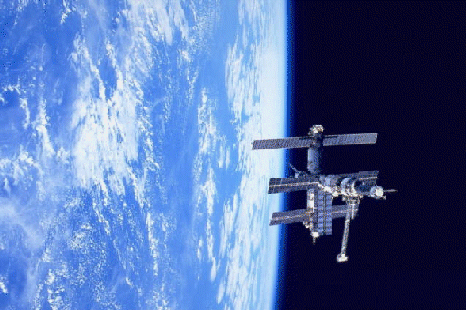 Earth, of course, can be studied without the aid of spacecraft. Nevertheless it was not until the twentieth century that we had maps of the entire planet. Pictures of the planet taken from space are of considerable importance; for example, they are an enormous help in weather prediction and especially in tracking and predicting hurricanes. And they are extraordinarily beautiful.


 71 Percent of the Earth's surface is covered with water. Earth is the only planet on which water can exist in liquid form on the surface (though there may be liquid ethane or methane on Titan's surface and liquid water beneath the surface of Europa). Liquid water is, of course, essential for life as we know it. The heat capacity of the oceans is also very important in keeping the Earth's temperature relatively stable. Liquid water is also responsible for most of the erosion and weathering of the Earth's continents, a process unique in the solar system today (though it may have occurred on Mars in the past).
 The Earth's atmosphere is 77% nitrogen, 21% oxygen, with traces of argon, carbon dioxide and water. There was probably a very much larger amount of carbon dioxide in the Earth's atmosphere when the Earth was first formed, but it has since been almost all incorporated into carbonate rocks and to a lesser extent dissolved into the oceans and consumed by living plants. Plate tectonics and biological processes now maintain a continual flow of carbon dioxide from the atmosphere to these various "sinks" and back again. The tiny amount of carbon dioxide resident in the atmosphere at any time is extremely important to the maintenance of the Earth's surface temperature via the greenhouse effect. The greenhouse effect raises the average surface temperature about 35 degrees C above what it would otherwise be (from a frigid -21 C to a comfortable +14 C); without it the oceans would freeze and life as we know it would be impossible. (Water vapor is also an important greenhouse gas.)
 The presence of free oxygen is quite remarkable from a chemical point of view. Oxygen is a very reactive gas and under "normal" circumstances would quickly combine with other elements. The oxygen in Earth's atmosphere is produced and maintained by biological processes. Without life there would be no free oxygen.
Geomagnetism FAQ
 The gas planets do not have solid surfaces, their gaseous material simply gets denser with depth (the radii and diameters quoted for the planets are for levels corresponding to a pressure of 1 atmosphere). What we see when looking at these planets is the tops of clouds high in their atmospheres (slightly above the 1 atmosphere level).
 Three distinct layers of clouds are believed to exist consisting of ammonia ice, ammonium hydrosulfide and a mixture of ice and water. However, the preliminary results from the Galileo probe show only faint indications of clouds (one instrument seems to have detected the topmost layer while another may have seen the second). But the probe's entry point (left) was unusual -- Earth-based telescopic observations and more recent observations by the Galileo orbiter suggest that the probe entry site may well have been one of the warmest and least cloudy areas on Jupiter at that time.
 Jupiter and the other gas planets have high velocity winds which are confined in wide bands of latitude. The winds blow in opposite directions in adjacent bands. Slight chemical and temperature differences between these bands are responsible for the colored bands that dominate the planet's appearance. The light colored bands are called zones; the dark onesbelts. The bands have been known for some time on Jupiter, but the complex vortices in the boundary regions between the bands were first seen by Voyager. The data from the Galileo probe indicate that the winds are even faster than expected (more than 400 mph) and extend down into as far as the probe was able to observe; they may extend down thousands of kilometers into the interior. Jupiter's atmosphere was also found to be quite turbulent. This indicates that Jupiter's winds are driven in large part by its internal heat rather than from solar input as on Earth.
 The Great Red Spot (GRS) has been seen by Earthly observers for more than 300 years (its discovery is usually attributed to Cassini, or Robert Hooke in the 17th century). The GRS is an oval about 12,000 by 25,000 km, big enough to hold two Earths. Other smaller but similar spots have been known for decades. Infrared observations and the direction of its rotation indicate that the GRS is a high-pressure region whose cloud tops are significantly higher and colder than the surrounding regions. Similar structures have been seen on Saturn and Neptune. It is not known how such structures can persist for so long.
 Jupiter has rings like Saturn's, but much fainter and smaller (right). They were totally unexpected and were only discovered when two of the Voyager 1 scientists insisted that after traveling 1 billion km it was at least worth a quick look to see if any rings might be present. Everyone else thought that the chance of finding anything was nil, but there they were. It was a major coup. They have since been imaged in the infra-red from ground-based observatories and by Galileo.
 In July 1994, Comet Shoemaker-Levy 9 collided with Jupiter with spectacular results (left). The effects were clearly visible even with amateur telescopes. The debris from the collision was visible for nearly a year afterward with HST.
 Jupiter has 67 known satellites : the four large Galilean moons plus many more small ones some of which have not yet been named:


very nice
ردحذف